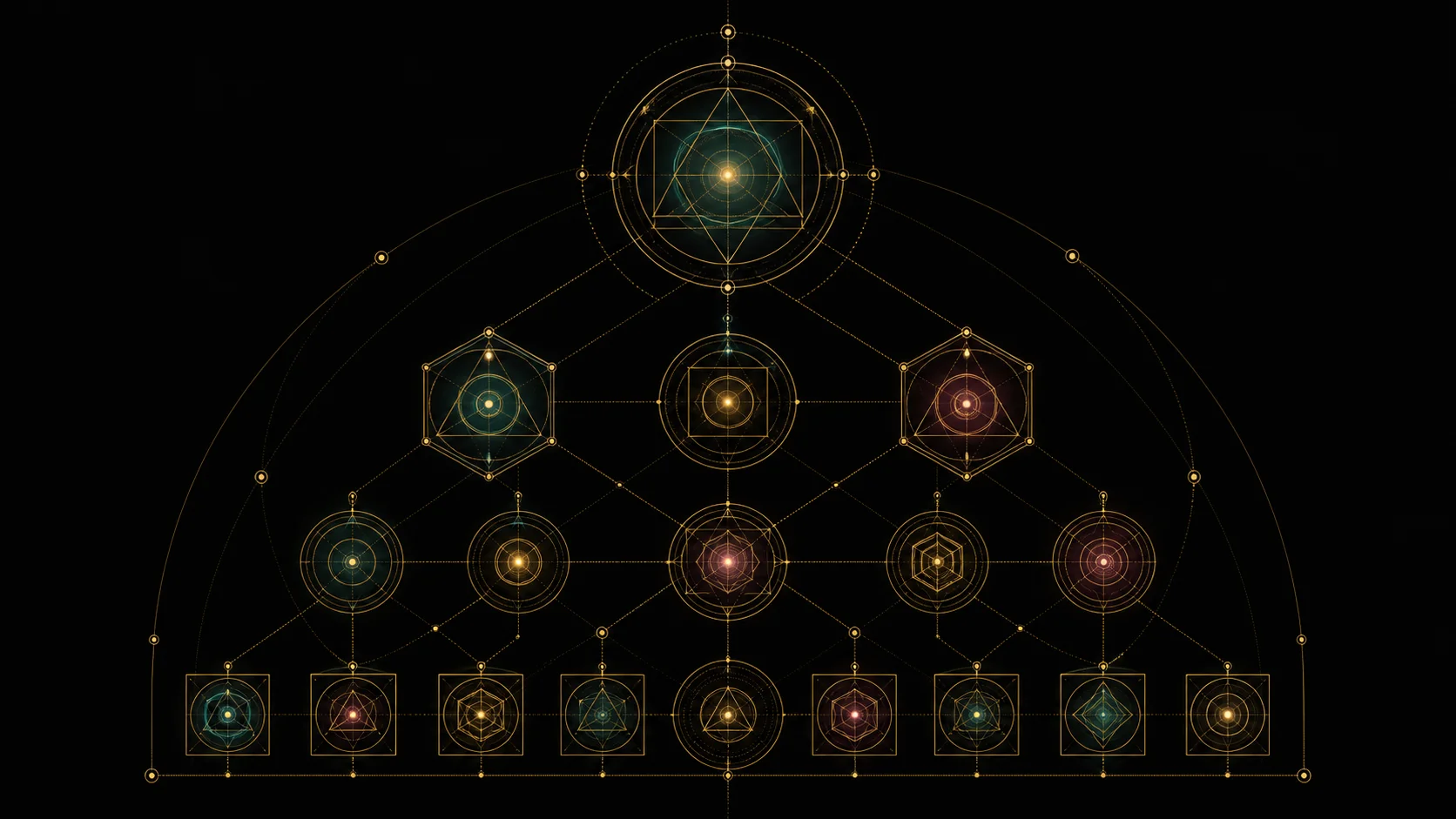
Spiral Dynamics is useful as a diagnostic instrument and useless as a hierarchy. The spiral is not a ladder to climb. It is a map of conditions that produce different developmental stances. Here is how to use it without the cult, the moralizing, or the team-sport framing.
The Problem with Spiral Dynamics
Spiral Dynamics (Don Beck, Chris Cowan, based on Clare Graves) describes human development as a sequence of "memes" or value systems: Beige (survival), Purple (tribal), Red (egocentric), Blue (authoritarian), Orange (achievement), Green (communitarian), Yellow (systemic), Turquoise (holistic).
The model is empirically grounded in developmental psychology. Graves' research tracked how adults' worldviews shift under different life conditions. The "spiral" is a description of the conditions that produce different stances, not a prescription for which stance is best.
The problem is that the model has been co-opted into a hierarchy. "I'm Yellow, you're Green" becomes a way of ranking people. "We need to move to Second Tier" becomes a goal to achieve. The spiral becomes a ladder. The diagnostic becomes a credential.
This is not just a misuse. It is a fundamental misreading of the model. Graves' research showed that developmental stances are responses to life conditions, not achievements of personal growth. You do not "reach" Yellow by meditating. You shift to Yellow when the conditions you face require systemic thinking, and you shift back when the conditions change.
The Diagnostic Reframe
Used as a diagnostic instrument, Spiral Dynamics answers a specific question: what conditions is this person/organization/culture responding to, and what developmental stance do those conditions produce?
This is a structural question, not a moral one. It does not ask "is Green better than Blue." It asks "what conditions produce a Green stance, and what conditions produce a Blue stance, and which conditions are present here."
The diagnostic is useful because it names the stance without judging it. Blue (authoritarian, rule-following) is not "worse" than Green (communitarian, empathetic). Blue is the stance that emerges when conditions require stability, predictability, and shared rules. Green is the stance that emerges when conditions require collaboration, inclusion, and emotional intelligence. Both are appropriate responses to different conditions.
The diagnostic failure is assuming one stance is universally better. It is not. A Green organization in a Blue environment (where rules and hierarchy are necessary for survival) will fail. A Blue organization in a Green environment (where collaboration and inclusion are necessary for innovation) will also fail. The question is fit, not rank.
The Four-Quadrant Mapping
Spiral Dynamics becomes more useful when mapped across the four quadrants:
UL (subjective): the individual's interior developmental stance. What do they value? How do they make meaning? What is their relationship to authority, autonomy, community?
UR (behavioral): the individual's behavioral repertoire. What skills do they have? What coping strategies? What stress responses?
LL (cultural): the cultural container's developmental center of gravity. What does the culture reward? What does it punish? What is speakable and what is unspeakable?
LR (structural): the structural conditions. What economic, political, and institutional forces shape the environment? What are the material constraints?
A developmental stance is sustained by all four quadrants. Changing the UL (therapy, coaching) without changing the LL (culture) or LR (structures) produces a mismatch. The individual develops, but the environment does not, and the environment pulls them back.
This is why personal growth work alone does not change organizations. The individual shifts (UL), but the culture (LL) and structures (LR) remain at the old stance. The individual either leaves, burns out, or reverts. The diagnostic tells you which quadrant to intervene on, and why single-quadrant interventions fail.
The Organizational Diagnostic
For organizations, the diagnostic question is: what is the developmental center of gravity, and what conditions are sustaining it?
- If the center of gravity is Blue (rules, hierarchy, compliance), the conditions are likely: high regulatory burden, low trust, predictable environment, large scale.
- If the center of gravity is Orange (achievement, competition, results), the conditions are likely: market pressure, individual accountability, measurable outputs, growth phase.
- If the center of gravity is Green (collaboration, inclusion, process), the conditions are likely: knowledge work, long-term relationships, complex coordination, post-scarcity.
- If the center of gravity is Yellow (systemic, adaptive, integral), the conditions are likely: high complexity, rapid change, cross-domain integration, long-term horizon.
The diagnostic is not "we should be Yellow." The diagnostic is "our conditions produce Orange, and our strategy requires Green. Either change the conditions or change the strategy."
The Anti-Cult Protocol
Spiral Dynamics attracts cult-like usage because it offers a credential ("I'm Second Tier") and a hierarchy ("higher is better"). To use it as a diagnostic instrument, not a cult:
Never name another person's stage. You can name your own. You cannot diagnose someone else's without their participation. Naming others is the first step toward ranking.
Never use the model to win arguments. "You're reacting from Blue" is not an argument. It is a dismissal. The model is for understanding, not for winning.
Always ask what conditions produce the stance. If you find yourself judging a stance ("Green is naive," "Blue is rigid"), ask: what conditions produce this stance, and are those conditions present here?
Treat the spiral as a map, not a ladder. The map shows what stances exist and what conditions produce them. It does not show which stance to be in. That depends on the conditions.
Be honest about your own stance. If you are using the model to feel superior to others, you are not at Yellow. You are at Orange using Yellow as a credential. The model detects this. So can everyone else.
What This Changes
For individuals: the question shifts from "what stage am I at" to "what conditions am I responding to, and is my response appropriate." The first question leads to ranking. The second leads to self-understanding.
For organizations: the question shifts from "how do we develop to the next stage" to "what conditions are producing our current stance, and do we need to change the conditions or the stance." The first question leads to transformation programs. The second leads to structural diagnosis.
For the field: the question shifts from "is Spiral Dynamics valid" to "is Spiral Dynamics being used as a diagnostic or a hierarchy." The first question is about the model. The second is about the usage. The model is valid. Most usages are not.
Spiral Dynamics is a map. Maps do not tell you where to go. They tell you where you are and what the terrain looks like. Where you go is your decision. The map is useful only if you use it to understand the terrain, not to rank the destinations.
For a diagnostic instrument that maps developmental stances across the four quadrants, take the Sigma Profile assessment.
Enjoying this?
Get weekly insights on consciousness, systems, and sovereignty.
Share
Comments
Sign in to join the conversation.